
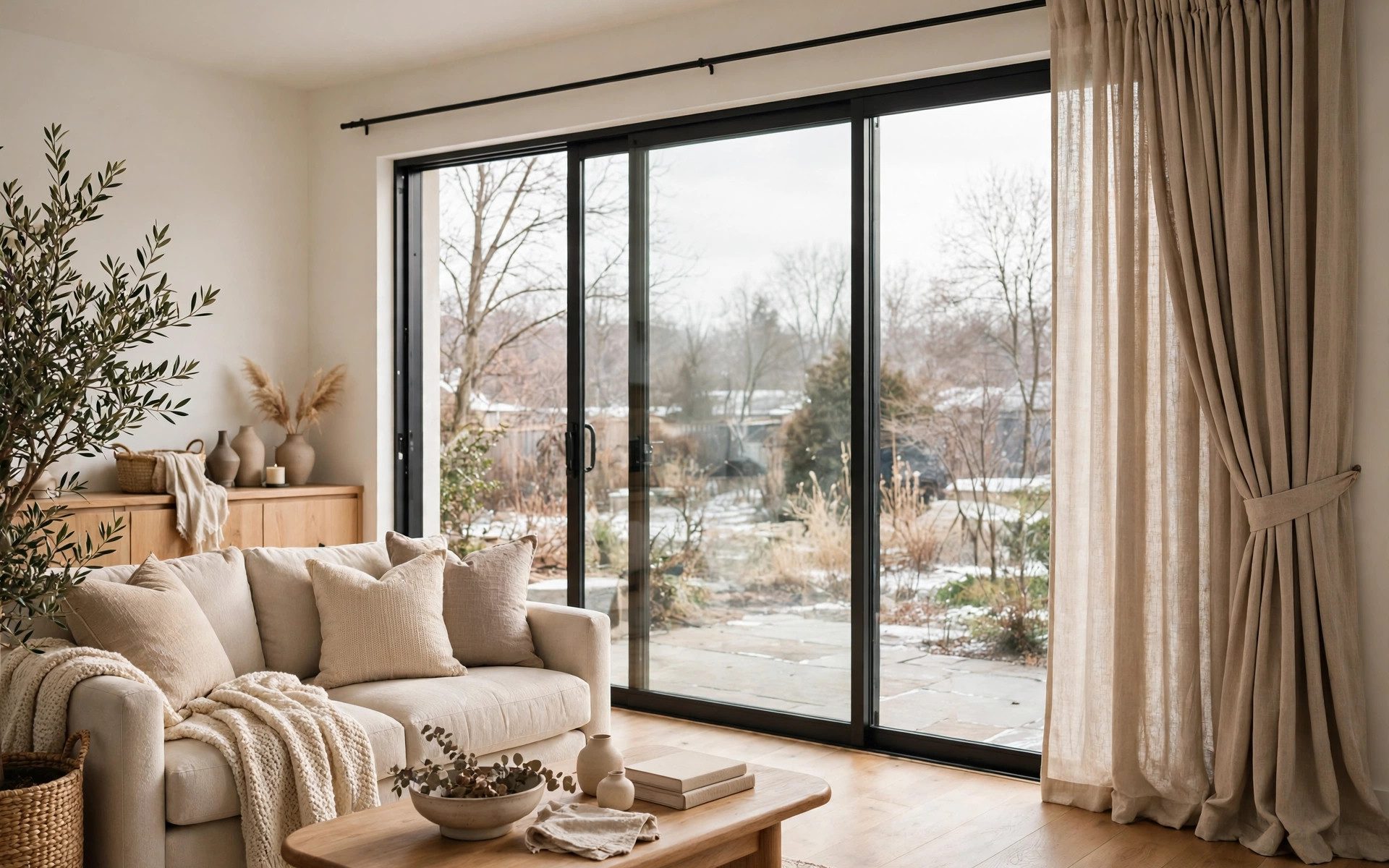
Curtains for sliding glass doors matter most in winter: a sliding glass door is the largest pane of glass in most living rooms, and the opening you use every day. A wide span, a door that has to move, and a handle and track that stick out are why ordinary curtains often fail here — panels too narrow leave a gap, a low rod makes the door look squat, and a header that will not glide turns a quick trip outside into a tug-of-war. The fix is straightforward: measure generously, hang the curtains high and wide, choose a winter fabric, and fit hardware that lets the panels slide easily and close fully.
Table of Contents
Why Sliding Glass Doors Need a Different Approach
A standard window is fixed. A sliding door is a working opening, usually 72 to 96 inches wide, with overlapping panels, a bottom track, and a handle that projects into the room. Curtains must clear all of that, cover the opening when closed, and stack over the wall when open. The usual mistakes are buying window-sized panels, mounting the rod just above the frame, and choosing hardware that does not move well.
How to Measure Curtains for Sliding Glass Doors
Width: Full Opening Plus 10–12 Inches on Each Side
Measure the full width, from the outside edge of the trim on one side to the outside edge on the other — not just the glass. Then add 10–12 inches on each side. That gives the curtains somewhere to stack when open, over the wall rather than over the glass, so you keep the view and the door opens fully. It also lets them overlap the frame when closed, closing the light gaps at the edges. For a 72-inch door, that means a rod roughly 92 to 96 inches long; for a 96-inch door, around 116 to 120 inches. Plan for a center support bracket, or a long rod will sag under heavy panels.
Height: Mount the Rod 4–6 Inches Above the Frame, or Near the Ceiling
Mount the rod 4–6 inches above the frame as a minimum, or near the ceiling if the room allows. Hanging high makes the ceiling feel taller and gives a longer drop, and helps with drafts. Measure from the rod position to the floor. Full-length panels should just brush the floor, or sit about half an inch above it in a busy doorway. For a ceiling track, measure ceiling to floor and subtract about an inch for track and hooks.
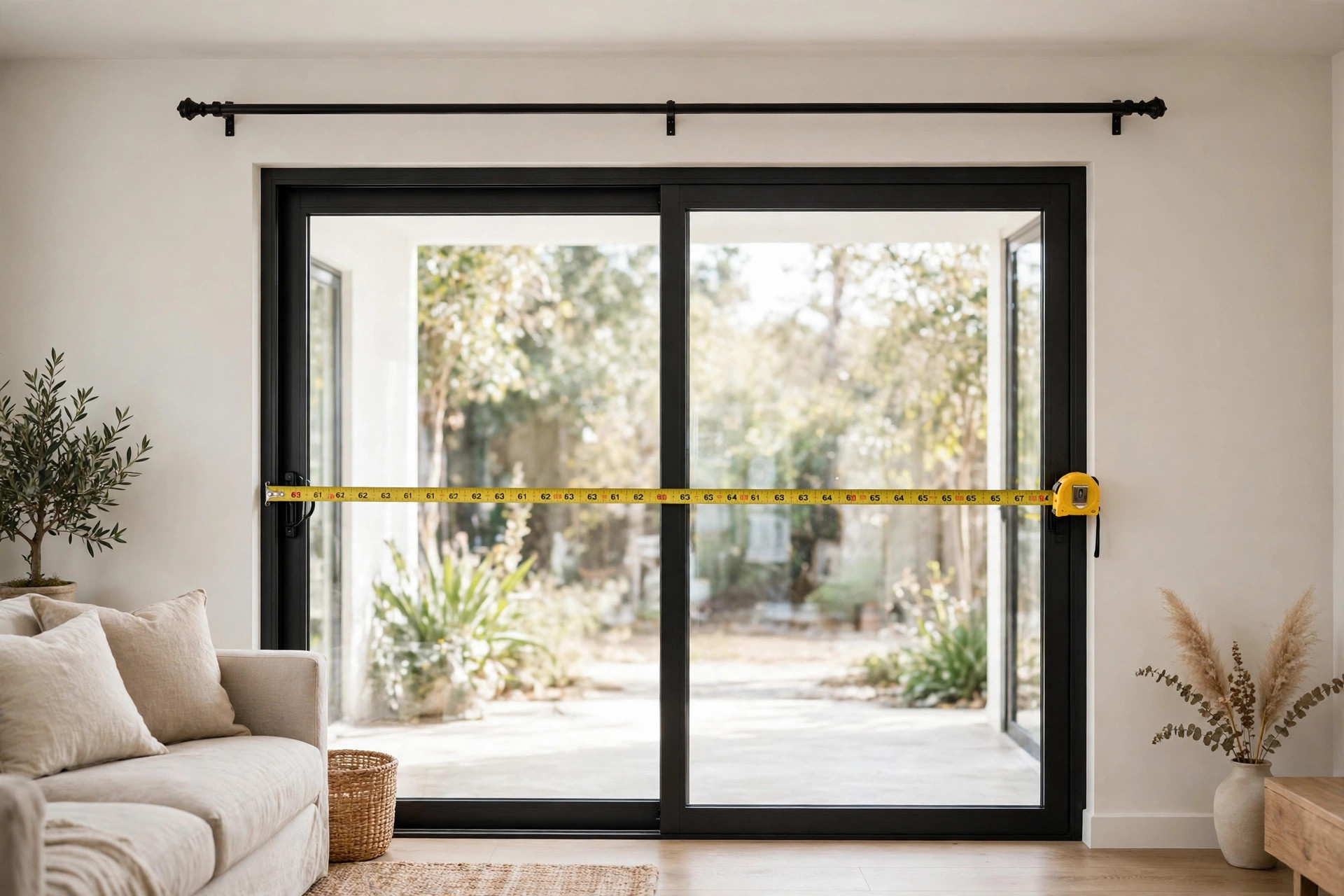
How Wide Should Curtains for Sliding Glass Doors Be?
Total panel width should be 1.5–2 times the rod length. That fullness gives curtains their folds; without it, panels hang flat and leave gaps. For a 96-inch rod, that is 144 inches at 1.5 times, or 192 inches at 2 times, split across the panels — two 72-inch panels give 144 inches, two 96-inch panels give 192 inches. Heavier fabrics sit at the upper end.
Standard panels are often 50 to 54 inches wide, so you would need three or four for a sliding door. Extra-wide panels — often 100 inches or more per panel — are made for this job: one per side can cover a standard door with proper fullness. Add up the stated widths before you buy, and size up if you are between sizes.
Blackout vs Thermal vs Sheer
Choosing between blackout, thermal and sheer fabrics is the main decision for curtains for sliding glass doors, because each one solves a different winter problem.
Blackout Curtains
Blackout curtains for sliding glass doors block light, with a dense weave or blackout lining that stops most daylight passing through the fabric. Blackout does not automatically mean thermal, and thermal does not automatically mean blackout, although many winter panels combine both. Light will still slip around the sides and top if the rod is too short or the panels are too narrow, so choose lined panels with a substantial feel.
Thermal Curtains
Thermal curtains reduce heat loss. They are usually heavier, often with a thermal lining or an interlining — a layer between the face fabric and the lining — that adds bulk and insulation. That slows heat escaping through the glass, and creates a heavier drape that seals better. They work best closed fully at dusk, fitted closely at the sides and bottom. Two panels should overlap slightly when closed, not just meet edge to edge.
The Cornell Cooperative Extension guide to energy-saving window treatments notes that conventionally hung draperies cut heat loss by only about 10%, while lined draperies sealed at all four edges can reach about 25% — which is why fit matters as much as fabric for curtains for sliding glass doors.
Sheers
Sheers soften the glass and give daytime privacy, but they are not a winter solution on their own. Use a sheer as a daytime layer behind a heavier panel. Choose blackout for light and privacy, thermal for warmth and drafts, and a lined blackout-thermal combination when both matter.
Hardware That Seals Light Gaps
Ceiling Track
A ceiling track is often the cleanest solution. Fixed to the ceiling, it lets the curtains cover the whole wall, with no visible rod and no gap above the frame — excellent for winter, as warm air cannot escape over the top as easily, and light cannot leak in above the curtain. Curtains hang from carriers inside the track, so even heavy panels move with a light pull.
Traverse Rod
A traverse rod has a cord or wand that draws the curtains open and closed. It is made for wide, heavy curtains opened and closed daily — exactly what a sliding door needs. Check the weight rating and length, choose a long, strong rod with center support, and keep the cord clear of the door handle.
Wrap-Around Rod
A wrap-around rod, sometimes called a French return rod, curves back to the wall at each end. When the curtains are closed, the ends are brought back to the wall, closing the side gap where light and cold air usually leak in.
Brackets Deep Enough to Clear the Handle
The brackets must be deep enough to clear the handle and the door track. Measure how far the handle projects — usually two to four inches, sometimes more — and add clearance for the fabric and header, so the panels hang freely and do not catch every time the door opens. If the handle is especially deep, look for extended brackets, or choose a ceiling track, which sits further forward.

Headers: Grommet and Pleated Slide Well, Rod Pocket Does Not
The header decides how easily a panel moves. Grommet headers — metal rings through the top of the fabric — slide smoothly along a rod and create deep, even folds, and suit heavier fabric because the rings spread the weight. Pleated headers — pinch pleats or pencil pleats — also slide well, and give a more tailored look. Rod-pocket headers, where the rod threads through a sewn channel at the top, are poor for daily use: the fabric bunches, friction builds up, and the panel is hard to pull across when heavy or lined.
How to Hang Curtains on Sliding Glass Doors
- Measure the full opening, plus 10–12 inches on each side, and the height from the planned rod position to the floor. Measure the handle projection, too.
- Choose hardware first. Decide between a ceiling track, a traverse rod, or a wrap-around rod, and check that the brackets clear the handle. Buy a rod long enough for the full span, with center support.
- Mount the rod or track level, 4–6 inches above the frame or near the ceiling, fixing into a stud or a proper wall anchor.
- Add up the panel widths. Aim for 1.5–2 times the rod length in total, and favour extra-wide panels.
- Test the movement and the seal. Slide the curtains fully open and closed, open and close the door, and check for light at the sides, top, and center at dusk. Open on sunny winter mornings; close at dusk to hold the heat.
Winter Styling and Mistakes to Avoid
Curtains for sliding glass doors do not have to look heavy in winter. A warm neutral — oatmeal, warm white, soft taupe, or muted sage — keeps the room bright on gray days. If you want a festive look for December, our Christmas curtains guide shows forest-green velvet and warm neutrals that work on large windows too. Layer a sheer for the day and a thermal blackout panel for the night. When open, the stack should sit over the wall, not over the glass.
Avoid these mistakes: measuring only the glass; buying panels that are too narrow; mounting the rod too low; using shallow brackets; choosing a rod-pocket header for a daily-use door; forgetting the center overlap; and leaving a gap at the bottom.
Frequently Asked Questions About Curtains for Sliding Glass Doors
What size curtains do I need for a sliding glass door?
Measure the full opening, including the frame, then add 10–12 inches on each side for the rod length. Total panel width should be 1.5–2 times that rod length — for a 72-inch door, a rod of about 92–96 inches and 144–192 inches of panel width in total.
How high should I hang curtains over a sliding glass door?
Mount the rod 4–6 inches above the frame as a minimum, or near the ceiling if the room allows. Hanging high makes the room feel taller and helps the curtains cover the top of the frame.
Are blackout curtains good for sliding glass doors?
Yes, when sized and hung correctly. They block light through the fabric, but light can still leak around the edges if the rod is too short or the panels are too narrow. Use a generous rod length and overlap the panels in the middle.
What is the difference between blackout and thermal curtains?
Blackout curtains block light; thermal curtains reduce heat loss, usually with a heavier fabric or a thermal lining. Many winter panels combine both.
How do I hang curtains on a sliding glass door without blocking the handle?
Use brackets deep enough to clear the handle and the door track, and test the clearance before you finish. A ceiling track also works, because it sits forward of the handle.
Should I use a curtain rod or a ceiling track for a sliding door?
Both can work. A ceiling track gives the cleanest top-to-bottom coverage and avoids the handle. A traverse or wrap-around rod suits you if you prefer a visible rod or cannot fix into the ceiling.
What curtain header is best for sliding glass doors?
Grommet and pleated headers are best, because they slide smoothly and stack neatly. Avoid a rod-pocket header for panels you move daily — it creates friction and is hard to pull across.
Can I use Christmas curtains on a sliding glass door?
Yes. Choose full-length Christmas curtains in a heavy fabric with blackout or thermal lining, hung high and wide so they clear the handle. For festive styling room by room, see our Christmas curtains guide.
Conclusion
The best curtains for sliding glass doors are the ones that fit properly, hang high enough, are wide enough to close without gaps, and slide easily every time you use the door. Measure the full opening plus 10–12 inches on each side, mount the rod 4–6 inches above the frame or near the ceiling, and aim for total panel width of 1.5–2 times the rod length, favouring extra-wide panels. Choose blackout for light, thermal for warmth, or a lined combination for both. Fit a ceiling track, traverse rod, or wrap-around rod with brackets deep enough to clear the handle, and choose a grommet or pleated header that glides rather than a rod pocket that sticks.